
Swan Songs:
The Alternating Currents of Hemingway and Capote

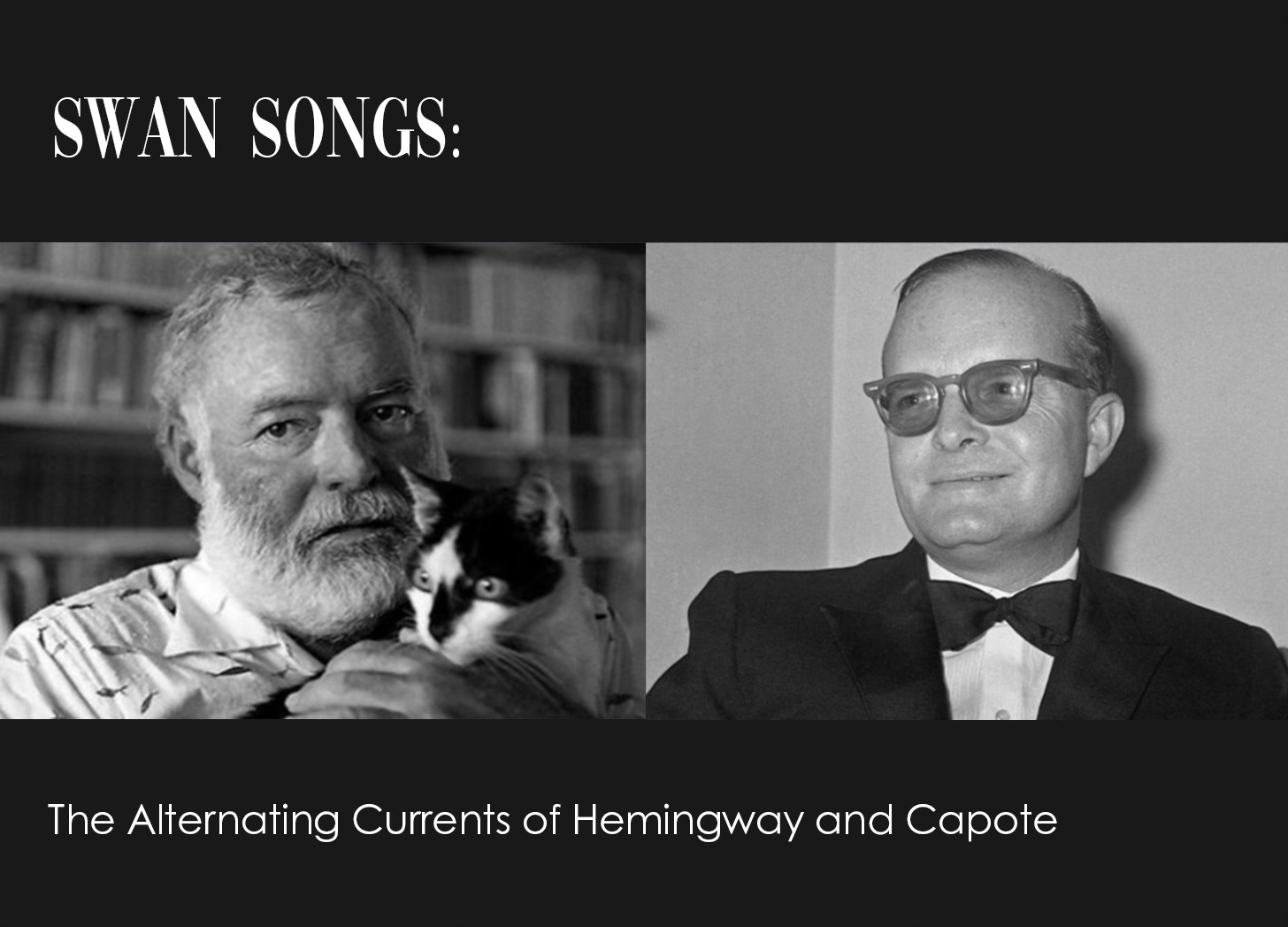
It is a delicious counterpoint to read the swan songs of Truman Capote and Ernest Hemingway side by side, an experience I recommend to all. No two books could be more different than Capote’s posthumous and incomplete final output, Answered Prayers, and the last book Hemingway published while living, The Old Man and the Sea. Yet somehow, the two make an unlikely sweet and savory combination.
Some might resist this invitation, rolling their eyes at Hemingway's schoolboy story, believing it is time to disregard the great patriarchal blowhard of American letters, to turn the page as it were, and make way for newer, more diverse voices. It is a fair point. Certainly, Hemingway’s moon is currently in its waning phase. But even Capote's characters can't help but wax reverently about "Papa." And as Capote so direly understood and elegantly illuminates, in both story and execution, trends come and go, but good writing endures.
Answered Prayers cattle brands the reader with its scalding wit. It delights in razor sharp excoriation of the aristocracy and its trail of social climbers and gigolos. Chief among the latter is the narrator P.B. Jones, a likely pseudonym of the author, who labeled his final and incomplete book a "nonfiction novel."
Capote takes the piss out of everyone and none so much as himself. All of the Unspoiled Monsters get their due and then are coolly dispatched. Even Kate McCloud disappears after her chapter. And while the novel (really a series of vignettes) is incomplete, I have a feeling that were the missing mystery chapters to appear, a coherent story would not be revealed. And why bother with form when the gossip Capote so blushlessly dishes makes it impossible to stop reading?
The Old Man and the Sea, on the other hand, leaves its lens in one very confined place, and it most certainly has a form, one so basic it might pass for allegory. But what surprised me most as a middle-aged person rereading the short novel is its simple ambition to render the agape love between a boy and a near-to-death old man. There are no bulls to fight, or elephants to shoot, no romance or Spanish revolutionaries to excite, and yet the stakes feel as encompassing as World War I.
Meanwhile, P.B. Jones is also dealing with hardship, struggles tufted in silk and populated by men with nine-penny cocks and women who stuff cherries in pussy for better cunalingus. Oh, what a thrill it was to leave Santiago starving in his little wooden skiff and escape for a while with “Jonesy” on a yacht where golden boy Denny Fouts rakes in royals and tycoons with his cocksmanship!
Really, reading these two books in the same week is a gift to the brain.
How much can we believe is real, though? The word on the literary street and late night TV had been that Answered Prayers was to be the tell-all of tell-alls, exposing well known socialites of the day, movie stars and notorious philanderers of the deepest pockets. But are we to believe that Capote had been a paid sex worker when we read that P.B. unflinchingly takes employment with the divinely caustic pimp, Miss Veronica Self? While many of the characters and their distilled stories are easily correlated to real life individuals and events, the line between the book's nonfiction and novel aspects is brilliantly blurry when necessary.
The Old Man and the Sea, on the other hand, aspires to be nothing but a novel. So, are you willing to go along with the idea that a near dead and starving old man could haul a thousand pound marlin out of the sea and kill five or six sharks on the way home? Sounds like poppycock to me. But then, when you find yourself seasick from all the backstabbing, ass pounding and menstrual sex in Answered Prayers, you may be willing to accept such a mad turn of oceanic events as entirely plausible. And that is precisely where Hemingway delivers. He makes you believe Santiago's journey is real.
Whatever you may feel about these two lionized authors, if you like one and not the other, or perhaps you disdain both, it is impossible not to respect them. And while these books are so conceptually and aesthetically disparate —one terse, the other florid; one embarrassingly pure, the other lavishly degraded, they share a similarity: neither will let you put it down. Unless, of course, you take my advice and read them side by side.
It’s a case of alternating current. A winsome and superior modality in which the alternation of texts delivers a superior voltage. I don’t think I could survive in Santiago’s world exclusively. And as decadent and tempting as Capote’s universe is, it’s clear, as he suffered it as much as he made it his ambition, the constellation of socialite icons that constitute cafe society is as devastatingly capricious as the cruel Sea.
With the series Duel: The Swans vs. Capote, plunging into the zeitgeist right now, we are all gifted a sumptuous safari into the lives of Capote’s notorious Swans. And the temptation to make a codex for these characters is ripe. Cleo Dillon as Babe Paley or Lady Ina Coolbirth as Lady “Slim” Keith of Castleacre. And who among us would not happily blush to be the source material for Kate McCloud, a character understood to be based on Mona von Bismark? It is a Page Six sinful pleasure to connect the dots. Even though most of these names have faded from memory and lost their relevance, they would only be further down the tunnel of oblivion were it not for Capote’s scandalization.
To Capote’s point (and maybe this is the point of Answered Prayers), the value to the public of the Swans lies not in their fortunes or who they were, but in their fictionalized selves as he portrayed them. It is his genius that phrased their existence in such a way to make it quaffable to any reader. It is his portrait that both condemns and immortalizes them. Because really, the Swans, without Capote, are a dime a dozen. Plug one in and the other out, they are each fine white birds that skim the surface of man made lakes, hardly distinguishable from one another.
So why rest the monocle on Swans and a world so alluring yet repellent? And how could Capote not anticipate the dismemberment of friendships that La Côte Basque would beget? Surely, he knew, even his attempts to render the women with a modicum of literary adoration could not mitigate their fury at being exposed. Sadly, Capote may not have had a choice. Where else might a late-stage artist of such refinement go? Alas, certain earthbound truths are impossible to avoid. Like the vastness of the sea and the weight of feathers.
Both Hemingway and Capote had parents who died of suicide, and both followed in their footsteps. Hemingway, who so brilliantly captured the essence of perseverance in the character of the Old Man, took the quick way out with a shot to the head. Capote did it slowly, murdering himself in a vichyssoise of pureed pills and blank-pages.
While many of their peers understood them in their late stage as faltering alcoholics, all the booze in the world cannot diminish what each had to say in their own personal final chapter.
“Is something wrong with the fish, you seem mad at it?”asks Capote of C.Z. Guest in the new TV series. The two are meeting to discuss the post-publishing fallout among the Swans. Capote’s probe is double-tongued. Obviously, it is not the fish that disappoints. But beyond that, he condescends the lack of material hardship. For the Swans know nothing of fish. They only know the filet.
The Old Man and the Sea, many will forget, as I had, ends with a tourist, perhaps a Swan, marveling at the bones of Santiago’s giant Marlin. “I did not know sharks had such handsome, beautifully formed tails,” says the misidentifying tourist, a two-paragraph character that arrives on the last page just in time to prove the point: few of privilege will ever comprehend the story of the Old Man. And who of modest origin would know what it is to be a Swan were it not for Capote?
Hemingway, as much as he was a dandy of fine tailored suits and known to quench his thirst on pricey Valpolicella, managed to capture the struggle of a poor fisherman to the same fine degree that Capote quintessentially depicted the murderous minglings of Manhattan’s elite. And while the temptation might be to disregard one book for the other, to decry the shallowness of the affluent, or mock the obvious profundity of the sea and an old man, we are better for both books' existence. After all, rich or poor, we all come from water. Anyone can admire the beauty of swans just as somewhere in the universal subconscious of us all lives the archetypal dream of lions on the beach.
can’t wait to read those. thanks for this, Sam! xo
All our english teachers and even Elsa Weiss would be very proud of you for this. As am I.