
Groupthink:
A Mass Delusion for Knicks Fans & the Death of Postmodernism

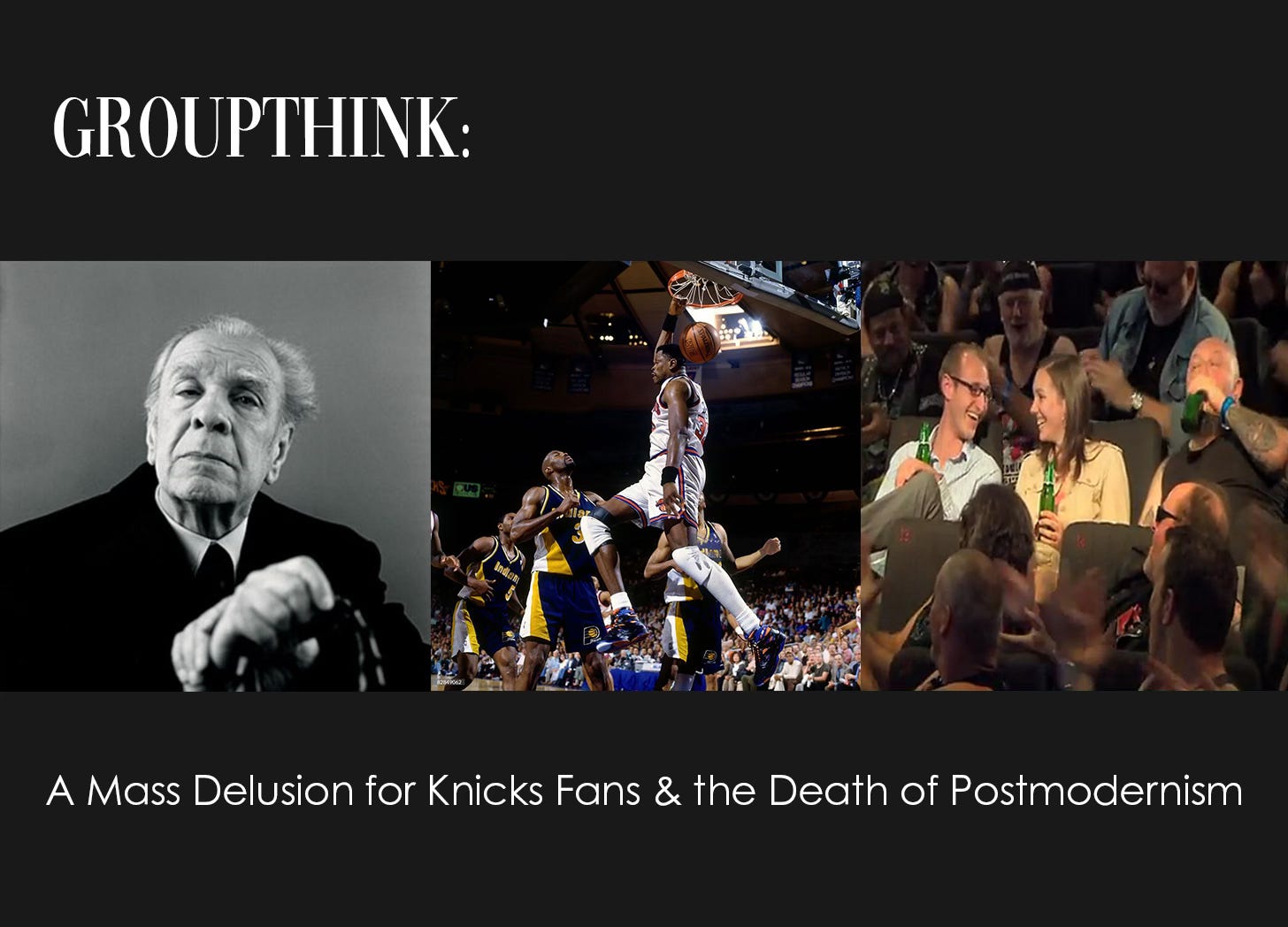
Groupthink is dangerous. Potent. Mobs are dumb. Cults are scary. How do intelligent individuals fall victim to peer pressure? The Age of Social Experimentation, born in the wake of WWII, sought answers. And none of the findings were good. Humans, as complex as we are, bestowed with more intelligence than any of the beasts, will generally behave like animals given the right circumstances.
Take a Knicks game for example. One of the best nights of my life transpired in Madison Square Garden, on May 17, 1995. A Knicks playoff game against The Indiana Pacers in which the audience became a single-minded entity, its groupthink so powerful as to affect the outcome of the game, as well as create a mass delusion.
Everyone was panicking. With seven seconds to go in Game 5, the Knicks faced elimination. Pat Riley called a timeout.
Great murmuring made its way through the Garden. Stench of spilt beer and hot dog breath. We looked to each other for comfort, but found none. All of our faith in the Knicks ability to play in clutch situations had been shattered in Houston a year before and then decimated by Reggie Miller who stole Game 1 by scoring an impossible 8 points in 9 seconds. The Pacers, we understood, were lethal in the final moments of a game, whereas the Knicks had busied themselves perfecting the art of the choke.
Fortunately, on this night, some MSG line producer, may they be praised in heaven, had a stroke of genius. A scene from Rocky II which perfectly articulated the moment projected on the Jumbotron. In the scene, Rocky is preparing to lose. He wants the comfort of knowing that Adrian will stand by him if he does. Yup. That’s how we all felt. But Adrian, tucked in hospital sheets, weak from having given birth to their first child, does not acknowledge Rocky’s weakness. Instead, she asks him for something: “You know what I want you to do for me … ?”
We waited with bated breath. What did she want?
“Win,” said Adrian. “Win!”
And as her whisper ricocheted off the rafters and made its way into our hearts, suddenly we were able to believe again. So when Burgess Meredith growled: “What are we waiting for?” and the screen went black, and the buzzer rang and it was time to resume play, all of the fans in the Garden screamed in unison, so profoundly that the din gave Ewing wings to score an impossible buzzer beater. Strangers hugged and grown men cried.
(Like I said, this was one of the best nights of my life, and its characteristics very much align with that of a cult experience.)
Now it’s easy for a person like me to fall in love with a game. Less likely that I'd fall for an old white pederast with a story about spaceships and eclipses. But people do. Some of your nicest neighbors are either in a cult or have survived one. And in Germany, nearly an entire nation was absorbed into one, one with such gravity it is a wonder if any individual could have escaped its pull.
Every Jew has asked themself what they would do if given the choice to collaborate or die. It has been a question posed to us since the first Inquisitions. But this is a common human dilemma. Be it Judaism or any other religion, nation, cause; who among us is prepared to die for an idea? Usually, it’s either Socrates or a suicide bomber. The rest of us will walk in the middle of the road to save our necks. Until it gets hot. Until there’s an inescapable group of people telling us what to do and how to think.
Groupthink phenomena are many. Perhaps infinite. So, in order to make sense of the topic, I thought it would be useful to research a few notable studies and see where I fell in with it all (presuming that I and my intellect would land somewhere in upper level management).
The Bystander Effect: When an emergency situation occurs, the Bystander Effect holds that observers are more likely to take action if there are few or no other witnesses. With the presence of a group, a person is more likely to do nothing, because groupthink frees the individual of responsibility. It is one of many embarrassing truths about mobs. Like, I could tell you that I’d dial 911 if I saw a lady get shot. But if there were 30 other people there and I was late to work, who can be sure? ... Even the most outwardly moral person has contradicted their own ideology as a result of the Bystander Effect. After learning about this phenomenon, I decided not to self flagellate.
The Carlsberg Social Experiment: Orchestrated by the beer company, the experiment showed the effects of prejudice and stereotypes. Set in a movie theater where all but two of the 150 seats were filled with rugged male bikers, unwitting couples entered. Some left, some took the final two seats. What would you do in this situation? Would you feel intimidated and leave? I like to think that I’d join the bikers. But, then again, there are other situations in which I would definitely split. Like, what if it were 148 seats taken by moms and toddlers? Or a theater full of drunk hooligans on vacation in Greece? I decided that it is OK to have Carlsberged… But I would not mention this to friends.
The False Consensus Effect: During the late ‘70s Lee Ross conducted experiments which found most people that were willing to carry a sign that said “Eat at Joe’s” assumed others would do the same. Similarly, those who refused to participate assumed others would not agree to carry the sign. That means, regardless of any conclusion we might draw on a banal activity, humans assume others will act as they do, that other people are by default in their group. Like when I have a good turkey sandwich, I assume everyone else would agree it is a good turkey sandwich. It doesn't even occur to me that someone might think it’s a bad turkey sandwich. How could they? As such, I was forced to admit that I definitely live in a fool’s paradise of false consensus.
Asch’s Conformity Experiments: 1950s psychologist Solomon Asch demonstrated that people would give the wrong answer on a test to fit in with the rest of the group. Who would do such a thing? Who would say the short line is long and the long line is short and why? How does it benefit them? It makes no sense. But then I think of all the mediocre plays that I’ve seen where I stood for the ovation and I realize that I too am a conformist.
So, with all the groupthinking I’m doing, I have to wonder what good was all that critical education my mother spent her hard-earned money on? What does it avail me to have read so much philosophy if none of the principles get applied when the rubber meets the road? What if I’m not a worthy individual, not the independent thinker I assume to be everyday, quite sure of my position on topics political and otherwise, but more like an ant following the line?
One recent psychological experiment about groupthink that I found fascinating involved simply interviewing students on slavery. The question they asked the students is: if they lived during a historical period in which slavery was normalized, whether in America, Greece or Africa, would they have held slaves?
It is no surprise that most students said they would not. But some students became outraged and vehement about holding slaves. Those that had such volatile reactions were termed aggressive joiners. Ironically, aggressive joiners are the types of people who would not only have held slaves, but would have beaten them publicly to demonstrate their virtue as slaveholders. Aggressive joiners are the kinds of people who would not just collaborate with Nazis, but quickly rise through the ranks. So beware of people hoisting their virtue flags. Today’s politically righteous are also yesterday’s Himmler minions.
But let’s take it back to the Garden. May 17, 1995. As ecstatic as it was to watch my beloved team win the game, as benign as the sport is, there under the surface lurked something quite evil. Something we all agreed to overlook.
In the parlance of the day, when someone committed a travel violation in the game of basketball, often it was said that person “took the train.” In reviewing the play on YouTube, it is undeniable that Patrtick Ewing did more than “take the train.” He took a cab and then a train, at which point he dribbled once, then he flew to Miami and back before finally taking the game-winning shot. It was a gross violation of the rules. But I’ll be damned if any New Yorker cared. I doubt any would have stood up for the rules of the game, and had the referee made the call, the right call, nearly everyone in that mob would have been outraged and many would have become murderous. The NBA would have needed a security detail to get that ref safely out of the City.
But why?
Why do we so easily eschew certain facts in favor of others that suit our purposes? This seems to be the mode of the masses, a serious contradiction of the era of thought we are supposedly inside, the era that has succeeded Postmodernism: The Era of Metamodernism.
With the advent of Postmodernism, we were all gifted the ability to see stories in their fragments, to see “Truth” as it had always been, a splintered thing, not the perfect symmetry that the Greeks possessed. Protagonists became sideshows. The story of a sneaker, more interesting than the life of the player who wore it. It all begins with Borges, where narratives of narratives become the central action, an occult text resurfacing that foments in the “real world” an iteration of the reality within the text. And then it ends abruptly with a noose around the neck of David Foster Wallace. The author that showed us jest is, if not infinite, as sprawling as the characters in his tome that (do or do not) circle around any single plot or idea.
The metamodern mode improves upon postmodernism by allowing for postmodern and modern thought to exist simultaneously. “It oscillates between a modern enthusiasm and a postmodern irony, between hope and melancholy, between naïveté and knowingness, empathy and apathy, unity and plurality, totality and fragmentation,” according to expert Robin van den Akker.
But I do not believe storytelling has caught up with metamodern thinking. Hopefully it will. You could say Paul Auster kept the torch burning for a while, but really we are in a pragmatic entertainment-centric period in which novels (and now television series) do the bidding of politics, and the stories we engage in rarely challenge our thinking or leave the reader anything to interpret. What sells seems to be what confirms for consumers what they already believe. As such, our thinking is not confronted and the favored endings of stories currently are the ones most definitive and Dickensian. Fine with me. I love a good plot twist. But still, something is lacking. An honesty, an openness of the author’s intent not dissimilar to the Knicks fan unwilling to admit the travel violation.
In such a context, where good and bad are so plainly understood within narrative, the bad players always win. Like Trump, Russia and China, for example. Powers that can spin their specious binary narratives all over the internet with impunity. Lucky are the dictators of today. Because the new groupthink is all online, available to anyone and proprietary to Zuckerberg and Musk. The social experiment is no longer conducted within the confines of a prison or a laboratory. The laboratory is the network. All of these group dynamics are playing out in text and image, before and regardless of any veracity. The potential for misappropriation is massive, and the influence on the individual is greater than previously imaginable. But still, each individual believes they are an independent thinker, that their feed is somehow real.
How could we not? We are tribal in our DNA. We have forever lived in communities maxing out in the hundreds, like a church, and some, like mine, as small as a family of two. No one is actually an individual. More realistic, we are molded from and by each other. Still, it is an affront to admit, humans have forever been subsumed by groups and willingly conformed to their rules, from Madison Square Garden, to the Danish movie theater and German concentration camps.
My ego resists. I am me! It howls at the black night. Have I no free will? Didn’t physics say each and every point in the universe could be considered its center? Because as the universe expands, all loci move away from each other like raisins in a rising loaf of bread.
Shame on me for being a Bystander, a Calsberger, living in my own consensus like an Asch-hole. Forgive me reader. For though I be a raisin, I am a good and important one, god dammit! And this particular raisin is a Knicks fan, and WE all know where the center of the universe is this spring, the spring of 2024, because we have waited for it, nestled underground with the cicadas, for twenty years. It’s back in the Garden!
Cue the Close Encounters of the Third Kind clip on the jumbotron. We have presaged this, have we not? In a most Borges fashion, we molded the spaceship of clay with our own hands, until now at last it gyres above us shining like a giant championship ring in the night sky as the NBC tritones play on futuristic synthesizers, speaking in galactic tongues. I’m not trying to convince you to become a Knicks fan. I just want you to know, I would never join a cult or wear a swastika, and I definitely wouldn’t shy away from a room full of burly bikers. I am Sam. I have good thoughts. I believe in equality and justice for all. And I can acknowledge that even a Pacer fan might have a metamodern notion from time to time. But, let me assure you, this year, Indiana is on the wrong side of history.